Kiteba: A Futurist Blog and Resource

Strategic Foresight: Knowledge Ideas Technology Ecology Biology Architecture


Leave a comment

Open Thinking vs. Platform Thinking: A Meditation on Adorno

“Open thinking points beyond itself. Beyond all specialized and particular content, [open] thinking is actually and above all the force of resistance …”  — Theodor W. Adorno, from “Resignation,” Collected in The Culture Industry.

In our rapid, collective development of the future, as well as in our lived experience of the present, we have come to depend so much upon platforms. Especially in technology.

But we use the term “platform” pretty broadly now, don’t we? I have heard people call all kinds of things a “platform.” Everything from an electronic device to a skill set to parenthood.

Whether we mean a specific hardware-software architecture, or something more metaphorical, we must remember that platforms are there not only to make possible specific activities, but also to set meaningful limits on those activities.

Like the chess platform — consisting of chessboard, chess pieces and the rule set itself — all platforms facilitate a rich set of activity, interaction and potential innovation. The chess platform makes the game possible in all its infinite combinations, on one hand, but it also constrains or limits what the game can be.

A platform provides utility. And a platform limits possibilities.

So platform thinking is playing within the rules of a game, and accepting the constraints inherent in that game. It’s incremental innovation space.

Open thinking, by contrast, is playing a different game, outside the limitations of the platform, that “specialized and particular content” to which Adorno refers. It’s a resistance, the kind of rebellion that can and sometimes does shift the paradigm. It’s pure innovation space.

It may mean supplanting the old platform with a new one.

Or it may mean moving beyond platforms entirely.

Either way, it’s cool.


Leave a comment

Shapeways: A Social 3D Printing Platform and Marketplace

If you’ve been following the rapid development of 3D printing, you’re probably as amazed by the possibilities as I am. One of the things I love about it is that it’s a grassroots DIY movement open to the masses, so it takes manufacturing out of the normal scope and scale we’ve been used to for centuries.

Another thing I love: not only can you design and print a real, customized and usable 3D object with a wide range of affordable 3D printers, but  you can also upload, share and download designs on the web. I imagine a future where we won’t buy hard goods from stores; rather, we’ll download a CAD file of the thing we want and print it right at home.

Make Magazine is a rich central resource for 3D printing and a variety of other “maker” activities. Check out the 3D printing workshops and other content on their 3D printing blog.

A great new example of the social possibilities shaping up for 3D printing is Shapeways, a New York startup that bills itself as “a growing online community and marketplace … that harnesses 3D printing to help you make, buy and sell anything you want.”

Check out their video on How 3D Printing works:


At Shapeways, you can upload your own 3D design or use their online design tool. You can also sell your creation, or buy something from someone else. An important feature of the Shapeways service is that they do the printing for you, which may or may not turn you on. If nothing else, it’s a great way to try out 3D printing, without buying a printer.

The prototype of tomorrow’s hard goods marketplace may have just arrived.


1 Comment

Extreme Futurist Festival 2012: Los Angeles, December 21-22

More awesome futuristic stuff …

The second annual Extreme Futurist Festival (XFF) will take place in Los Angeles this coming December 21 and 22. XFF is billed as an arts and technology festival, where “counterculture meets academia.” So take cutting-edge technology and add some techno music, throw in some freaks, geeks and dreadlocks … but wait, XFF aspires to be more than just a nostalgic remix of late-’90s rave culture.

From what I can gather, XFF is also an embodied statement on who gets to participate in the creation of the future, and a reaction against the perceived marginalization of youthful individualism by big institutionalized futurism. In a way, it seems to be a call to arms for the futurist fringe, via transhumanist philosophy. According to the XFF’s statement on Kurzweil AI, “It is time to rise against the dominant current of our society and declare that nothing is too extreme. We refuse to be assimilated into a carbon copied version of a new humanity. As evolutionary agents we will push the boundaries of what it means to transform our species.”

Potent words, the stuff of daring youth. And here’s the XFF trailer:

Extreme Futurist Festival 2012 Trailer from H+ Worldwide on Vimeo.

The XFF was organized by Rachel Haywire, a futurist author and the editor of Humanity+ Magazine. Check out an interview with Rachel on the XFF here. The Fest is also sponsored by Humanity+, but it was at least partially financed through a crowd funding effort on RocketHub.

Anyway, it promises to be a beautiful thing, so if you’re in the LA area at the end of the fabled Mayan calendar (i.e., December 21, 2012), support it if you can.


Leave a comment

Dear Businesspeople: The Status Quo is NOT Your Friend

Despite my concern for ethical and social issues in previous posts, and in my academic lectures, never assume I am anti-business. Like anything, business can be a force for not-so-good as much as for good. However, business, when at its finest, creates value for society, improves lives, extends human horizons and, yes, paves the road to the future.

Plus, many of my best friends are businesspeople …

But let me say this clearly to my friends in business: The status quo is NOT your friend.

The rate of change in our business, tech, and social environment is too fast. And the barriers to entry in most industries are too low. That great new venture you got funded, that innovative new business model you invented, that great new product you just launched — they all hit the world with virtually no shelf life. At the moment of launch, someone already has something better in the works, someone else gets busy copying what you did, someone else entirely begins working furiously on making you obsolete.

Today, I still see so much energy put into maintaining various aspects of the status quo in business, especially business models and product offerings. We believe we are smarter or bigger or more experienced than everyone else. We believe we can leverage our experience and initial momentum in the market. We believe that if we just landed a few more big fish customers or built a few more headline-making strategic partnerships, we can extend the present into the future. We believe we can win in the game we know, if only it can stay the game we know.

And it will work. For a while.

But your success today can feed your failure tomorrow. The clock is ticking — your ideas are aging, your model is aging and the future is out there in those little pockets of competition, lining up to knock you off your mountain.

The status quo is not your friend. It will betray you, and it will diminish the great contribution you have the ability to make to our world as a business and/or businessperson.

So don’t stop innovating. Don’t stop learning and growing. Be the one that undermines your business model with the next big thing. Develop the product that makes your own product obsolete.

It’s your only hope.


1 Comment

Futurist Artist Cory Jespersen

A big part of creating the future is being able to visualize it, to draw it and illustrate what it might look and feel like. We need artists (we also need to be artists) to create the future.

In this post, I’d like to showcase the work of futurist artist Cory Jespersen.

Some background: I used to work at the big-box retailer PetSmart several years back, first as an Associate Creative Director, then as a Senior Marketing Manager. I hired and worked with some incredible people at PetSmart, including designer and artist Cory Jespersen.

I remember looking at Cory’s portfolio in the hiring interview. He had some good retail design work and also some weird fantasy and sci-fi sketches and paintings, the kind of stuff that might turn off some corporate creative directors.

But me, I thought, awesome. I hired Cory and he was indeed awesome. He still is.

Cory has developed his futuristic art chops since that time, and with his permission, I’d like to share some of his work. It’s wonderful, imaginative stuff, so check it out:


Also, visit Cory’s site at www.coryjespersen.com. Great work. Keep it up, Cory!


Leave a comment

Two Awesome Hoverbikes

I was eight years old when the original Star Wars film hit the theaters. Begged my parents to take me. Waited in line. Loved it. Wanted a light sabre. Didn’t understand why they hadn’t been invented yet.

I also wanted a Landspeeder, which presumably utilized some kind of anti-gravity. And while there’s no anti-gravity propulsion still, there are increasingly powerful fans. And they can be used to power hovercraft!

Here are two awesome hoverbikes.

First, this one from Aerofex in California:

Read the story on the Aerofex bike here.

Finally, this one from Australian inventor Chris Malloy:Click on the image above (courtesy of GizMag.com) to read the full story and see the great photo gallery.

A lot of development left to do here, apparently, but great design and innovation.

Three final words: I want one.


Leave a comment

A Good Futurist Needs …

According to Jim Dator, Director of the Hawaii Research Center for Futures Studies, to be a good futurist (and I quote Dator in italics), you need:

•  the widest possible knowledge of the history and present condition of as many cultures and civilizations as possible; you must know more than one culture, and thus more than one language, intimately,

• the widest possible knowledge of all aspects of all the social sciences,

• the widest possible knowledge of current and emerging developments in the natural sciences, and their emerging sub disciplines and transdisciplines, for example, evolutionary systems theory, chaos theory, and brain science,

• the widest possible familiarity with developments in engineering (especially electronics and genetics), architecture, and space sciences,

• the widest possible familiarity with philosophy, ethics, morals, and religions, and certainly the ethical discourse of as many different traditions as possible,

• the widest possible familiarity with law and planning,

• an active awareness of esthetics and the esthetic element in all aspects of life; a continuing experience of esthetic expression in some, or preferably many, modes,

• creativity, imagination, the willingness to think new thoughts, to make unmade connections, to be ridiculed, laughed at, and to laugh at yourself,

• the ability to synthesize, combine, invent, create,

• the willingness to be politically active, to test out new ideas on yourself first and while trying actually to create a better world, or some portion of it,

• the ability to try to anticipate the consequences of actions before you act, but also the willingness to risk failure and to learn from mistakes and criticism–indeed to seek out and provoke criticism–but to keep trying to do better, and constantly to relearn what ‘better’ might be,

• insatiable curiosity, unbounded compassion, incurable optimism, and an unquenchable sense of humor and delight in the absurd.

It’s an engaging (and daunting) list of interdisciplinary knowledge and open mindsets to master and develop, but I would also argue that these requirements are not just for the obscure profession of future studies. Today, as technology and globalization compress time and space, we all need to be doing at least some of this stuff. We all need to be futurists.

The future is happening now. And now. And now.

So build a tough reading list and start reading. Make connections across disciplines and cultures. Dream up an idea and prototype it. Test your assumptions. Let your curiosity run away with you.

Oh, and don’t forget to laugh a little.


Leave a comment

OpenIDEO: Crowdsourcing Innovation

The legendary product development and design firm IDEO has beta-launched OpenIDEO, a “crowdsourcing” site for innovative ideas for a variety of contemporary challenges. The concept is fairly simple: challenges are posted, ideas submitted, and a panel facilitates refinement and ultimate selection of a winning concept. You can join for free and participate in several different ways, from submitting ideas to helping in refining the ideas of others.

The challenges posted range from sustainability to education to medicine. If you’re creative and have ideas, it’s a fabulous way to interface with IDEO and a network of people like you. If you’re simply looking for inspiration, it’s a great place to browse about (see especially the Field Notes section).

The best part, to quote from the OpenIDEO site: “All concepts generated are shareable, remix-able and reusable by anyone – in a similar way to Creative Commons. The hope is that some of these concepts will become reality outside of OpenIDEO.com.”

Here’s their video introduction:


Exciting stuff, really. I see in OpenIDEO an intriguing model for all kinds of technological and social development projects. In a way, it’s a kind of democracy of ideas that neither completely dilutes the vision of the individual creator nor completely eschews the value of a rigorous vetting process. And because the concepts are shareable and resuseable, there’s the potential here to cultivate and coalesce creative problem-solving around big challenges and thus stimulate even more, even better solutions for our present (and future) challenges.


Leave a comment

Quick Sketch: A Semi-Automated Farming Pod

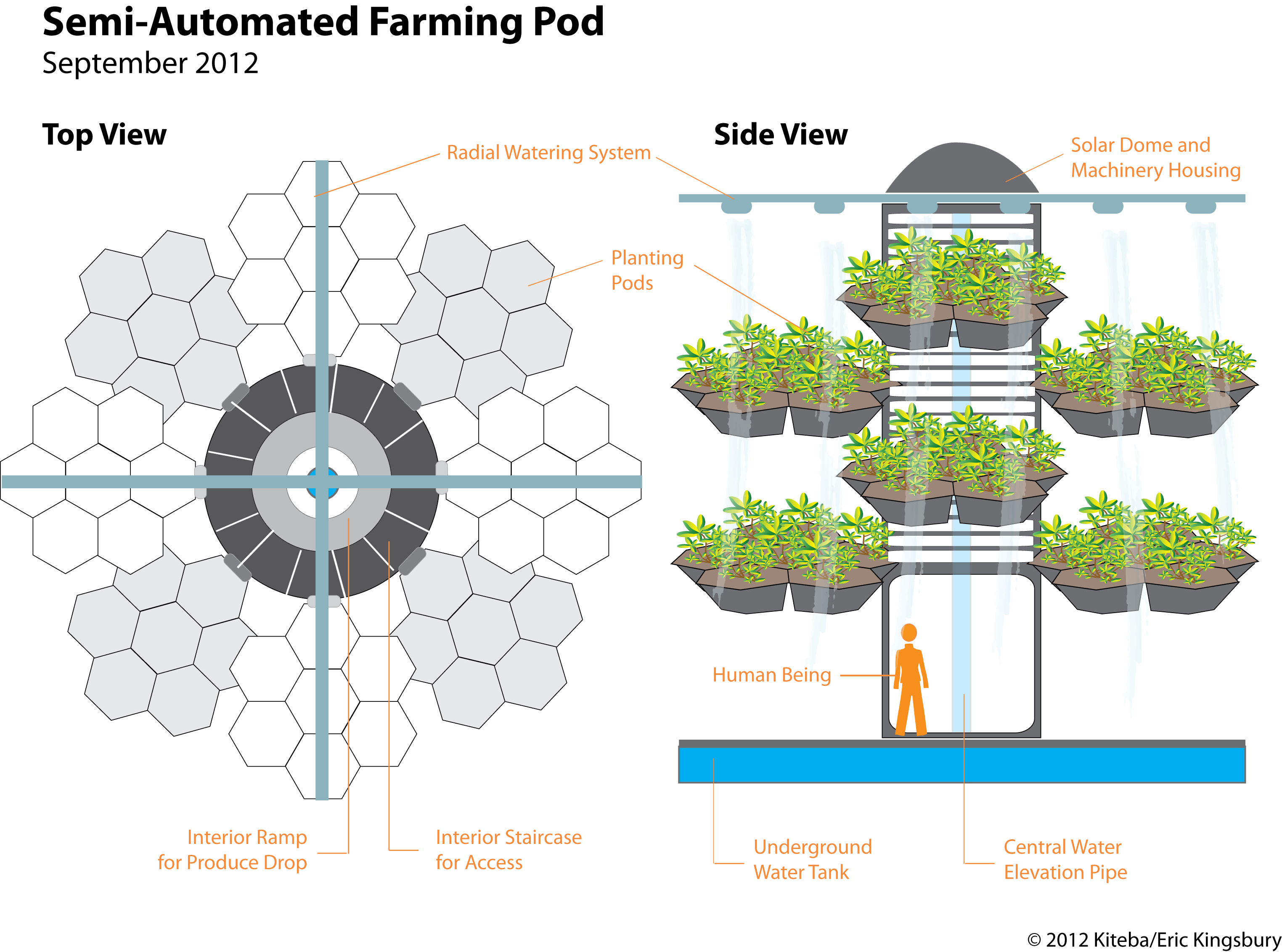
Great Labor Day weekend with friends and family in Albuquerque, New Mexico. Inspired by the landscape and hiking in the Sandia Mountains. Thinking about “machines of loving grace,” I sketched up a couple of techno-eco ideas, and here’s one (below). It’s an automated farming machine that uses suspended, interchangeable hexagonal pots, put into hexagonal pods of seven. These pods are suspended around a column, and a computer automates the watering and other processes. It’s solar-powered and reclaims some of its water.

At harvest time, just lower the pods and pick, or access the produce from the interior and drop it down an internal ramp.

Here’s the sketch:

Actually, it would be preferable if the machine did everything, but we’ll have to get to that. Lots of technical details to work out on this idea, but it’s an idea, a sketch. And good things start there.


Leave a comment

Facial Recognition, Situated Technologies and the Slippery Privacy Slope

A fascinating week of exploration for me. Key topics: facial recognition, situated technologies and the slippery privacy slope. Thinking about the future, again, is always about trajectories, convergences and the social, economic and cultural implications thereof. So here are three reflections and interesting stuff to check out and think about:

1. Facial Recognition: Immersive Labs.

Thanks to Immersive Labs’ CEO Jason Sosa for putting me and a couple of my colleagues together with COO Jill Miller for a product demo of their CARA adaptive facial detection application. The CARA system basically makes digital display screens in public spaces more intelligent and thus targeted by employing cameras and Immersive’s facial detection and content delivery technology. Through this tech, digital displays and billboards are able to detect who is looking at a display, whether they’re male or female, old or young; how long they look at the display; and presumably how engaged they are in the content of the display. The goal, of course, is first to be able to track, analyze and profile viewers of a specific display in a specific place, then to be able to deliver targeted content/advertising to that display, in order to better connect with viewers and achieve communication objectives.

The secret sauce here involves sophisticated algorithms that detect facial topography and accurately profile faces demographically. It’s amazing stuff that could be coming soon to every device with a camera and a display (tablets, phones, etc.); it will of course capture data that can be housed, analyzed and connected to other data. Right now, it’s fairly simple, but projecting it forward, facial recognition could connect people in real space with their virtual space activities, using big data analytics to profile and target further. It could also become sophisticated enough to note emotional nuances in faces and target messages based on those nuances. As a professional marketer working with targeted display, the opportunities here are intriguing to me short-term, but the way the twin technologies of facial recognition and intelligent display overlap with big data and the “internet of things,” that’s extremely interesting. The implications of the big data-enhanced internet of things are so fundamental as to literally change our world, and provide quite a few challenges, and I probably need to do a separate blog post on that convergence alone. Thanks again Jason and Jill, awesome stuff!

2. Situated Technologies

Great series of thought pieces here from the Center for Virtual Architecture, The Institute for Distributed Creativity (iDC), and the Architectural League of New York. These .pdf pamphlets take a look at some of the trends, issues and implications of a variety of technological and cultural areas. The most recent piece, Modulated Cities: Networked Spaces, Reconstituted Subjects, is a point and counterpoint between Helen Nissenbaum, an NYU professor of media, and Kazys Varnelis, a Columbia professor of “networked architecture.” As one might guess, the content here is a bit academic, so if you haven’t read cultural theorists like Lyotard, Habermas or Deleuze, you might miss some of the references. But it’s pretty up to date and accessible.

Anyway, key points for me here: 1) physical space (architecture and city planning) is becoming more and more intelligent and networked; 2) the physical world is beginning to model itself on the digital world (i.e, the relative dominance of the metaphors has reversed); and 3) there are tremendous social implications for both online and offline privacy, as the physical world becomes more digital, tech and data gets connected and integrated and values and social attitudes cultivated in the digital world are carried over into the material world.

Our built environment is trending toward “situated technology:” smart, networked, data-enabled space in which humans are potentially always already public, plugged-in, targeted and communicating, mediated by a screen or not. It’s also possible that it all (every thing) might converge into one network, which raises issues of power, access and control that we haven’t fully addressed yet as a species: if the world is a network of smart technology, all on one platform, who is the admin?

3. The Slippery Privacy Slope

Finally, in my undergraduate-level Strategic Management course this week, I took students through a facilitated strategic analysis of Yahoo! Yahoo! has been in the business press quite a bit because of its new CEO, Marissa Mayer. After we looked at Yahoo!’s business model, the business environment, competition, etc., the Yahoo! discussion, among my students anyway, really came down to: advertising, content, big data, and how Yahoo! leverages these assets. I raised the issue of privacy as an ethical cross-check to tempting potential uses of consumer data, but interestingly, the class had little concern about the company’s future use of data.

That’s right, even as consumers, they were not very concerned about threats to their privacy. The class’ attitude was, essentially: “Well, as soon as you get on the internet, you know you’re giving up your data.”

Through the lines, really, what I read from the class discussion was the collapse of data, permission and privacy, which Nissenbaum and Varnelis actually discuss in the piece I refer to in #2 above. The surrender of data is increasingly equated with the surrender of all privacy (thus, the slippery slope). It’s a capitulation that seems somewhat shocking — but many consumers see it as the exchange that in many ways it is. Consumers have more or less consciously traded their privacy for the benefits of technology, such as the free Facebook account.

Now, this one group of students is by no means a representative sample of the general population. Regardless, based on other casual data points, it seems we may be slipping down the privacy slope, and the old boundaries are likely to be pushed in the next year or two. As another example, this afternoon, I was online and saw ads on a news site that turned out to be targeted to me (via LinkedIn advertising) based on information in my LinkedIn profile. Hmmm.

We live in very interesting times, right?

Design a site like this with WordPress.com
Get started