Kiteba: A Futurist Blog and Resource

Strategic Foresight: Knowledge Ideas Technology Ecology Biology Architecture


Leave a comment

Finite and Infinite Games

One of my favorite quasi-philosophical books is James P. Carse’s Finite and Infinite Games: A Vision of Life as Play and Possibility. If you haven’t read it, you must. It’s an easy read, but it’s powerful. In this little aphoristic volume, Carse elucidates and explores the distinction between games/activities that are finite/closed systems and ones that are infinite/open systems.

To quote the basic premise of the book:

“There are at least two kinds of games. One could be called finite, the other infinite. A finite game is played for the purpose of winning, an infinite game for the purpose of continuing the play.”

The (admittedly imperfect) examples I picture in my mind: 1) a football game, with its agreed-upon time limits, scorekeeping and delineated field, is a classic finite game; and 2) a rock music performance, with its potentially loose structure, vaguely defined duration, and no clear objective evaluation criteria, is something of an infinite game. In the first, there is a final score; in the second, there is not. In the first, there is an agreed-upon winner and finite outcome; in the second, such terms make little sense.

So, taking this out to a macro scale, in our globalized capitalist market society, of course, there is a whole heck of a lot of finite game bias and even more winning and losing rhetoric. Even the smallest child can see it, as we’re conditioned from birth to play finite games and inevitably “gamify” life. A result of this finite game bias is that we also tend to sort people and groups of people into ever-shifting contextualized segments of winners and losers. Winning businesses are ones that dominate markets. Winning people are ones who have more money, have more fans on Facebook, whatever. Winning countries are ones that have the highest GDP.

It may seem innocent and natural enough, but the bias toward finite games is more than cheery sportsmanship or harmless temporary profiling (“sometimes you win and sometimes you lose”). Beneath the pervasive discourse of winning and losing is the slow but steady transformation of all spheres of human activity into finite games. Activities that are overly structured, overly quantitative, and often poorly scored. Our bias toward quantitative metrics is partially to blame, so also is our poor state of mass education, as we lose the skills to qualitatively evaluate things that are difficult to measure quantitatively.

Even more than that, perhaps, I think we as a society are developing a reluctance to play in or enjoy infinite-game type activities such as the arts or certain kinds of R&D, perhaps because they have no easy success metrics, and thus no easy rewards, or because we are addicted to winner/loser judgments and can’t deal with scenarios where the play is just play.

I would suggest that better future outcomes for our world depend upon reversing this trend toward viewing everything as a finite game. Or put another way, we have to begin to define success differently, as some have attempted to do with “eco-capitalism.” The sustainability of our natural resources depends upon breaking the finite game bias. Our ability to develop new solutions for our existing problems depends upon it as well. We simply have to begin to play to keep on playing, or we will not be able to innovate quickly enough to support our growing global resource needs, and our collective game will indeed become finite.

Please note that I’m not trying to be unscientific here. We do have to understand data and the quantitative dimensions of life, the universe, and everything, but then we have to get beyond them to creativity and true innovation.

To quote Carse again:

“Finite players play within boundaries; infinite players play with boundaries.”

That’s the rub: in order to build a good future, we will have to become infinite players.


Leave a comment

Moore’s Law and SyNAPSE

If you’re aware of the history of computers and machine intelligence at all, you know that raw computational power has come a long way since the early transistors. Gordon Moore’s famous law has more or less held up: the number of transistors that will fit on a microchip has doubled every 18 months or so, thus producing a steady increase in processing power, speed and storage capacity for so many of our digital devices.

Here’s Moore’s Law graphed out, courtesy of wikipedia:
As the fruits of Moore’s Law ripened, it became easy to imagine that machines would quickly become so smart that they would rival human intelligence. Yet alas, they haven’t yet. Despite this tremendous increase in machine computational power — and it is impressive, probably the single most driving force of human advancement in recent history — the dream of Artificial Intelligence, or of the Singularity, remains unfulfilled.

And Moore’s Law is slowing down and coming up against the laws of physics. There are many opinions on when the law might collapse, but here’s the always entertaining Michio Kaku discussing the issue:


As Kaku indicates, there are alternatives to the silicon and code path we’ve been beating for the past 50 years.

Here’s one: SyNAPSE, a project from DARPA.

To quote their site:

“Current programmable machines are limited not only by their computational capacity, but also by an architecture requiring human-derived algorithms to describe and process information from their environment. In contrast, biological neural systems, such as a brain, autonomously process information in complex environments by automatically learning relevant and probabilistically stable features and associations. Since real-world problems generally have many variables and nearly infinite combinatorial complexity, neuromorphic electronic machines would be preferable in a host of applications. Useful and practical implementations, however, do not yet exist.

“The vision for the Systems of Neuromorphic Adaptive Plastic Scalable Electronics (SyNAPSE) program is to develop electronic neuromorphic machine technology that scales to biological levels. SyNAPSE supports an unprecedented multidisciplinary approach coordinating aggressive technology development activities in the following areas: hardware, architecture, simulation, and environment.”

The approach here, then, is inspired by the brain, where the architecture is composed of simple units in a flexible structure that effectively responds to complex input. So the SyNAPSE vision is something along the lines of this chart they provided:

Simple systems with complex environmental capacity. Kind of like us, really. I am reminded of the human brain, which is again the SyNAPSE model, but I think also of much of nature. Consider colonies of ants or bees: together they make a flexible system of simple components that respond effectively to a complex environment. But the question is always whether the collective hive can be considered intelligent, or rather be considered an intelligence. And thus, we are back into the questions around artificial intelligence and the Singularity that I find so fascinating: will it be a single-system intellect or some kind of hive mind? Or could there be both? What is really possible?

Either way, I do believe there’s something great about the simple chart from the SyNAPSE project, above. That green star on the horizontal axis, labelled “human level performance” and “dawn of a new age,” that’s the Singularity, isn’t it? And see the yellow star? DARPA intends to get us closer.

SyNAPSE. Interesting project. Worth following.


Leave a comment

Scary Beautiful: The Future and Human Kinetics

Thinking about and prototyping the future often means pushing out boundaries and subverting expectations. It means rejecting and reinventing expected models, forms and interactions. And the momentum of the future finds expression in so many different ways. Often in big, obvious ways, but also in small, subtle, yet unforgettable ones.

For me, one of the most striking, often unintentional, expressions of the future is motion. New things move in new ways, or cause us to move in new ways. Think of the awkward, compelling kinetics of early computer graphics, of Second Life, or of people interacting with new technology. Have you ever walked in a hallway filled with people texting on their phones?

Inevitably, the visceral and the kinetic are secondary, accidental canvases upon which the raw power of new technologies and modes of being find expression. Yet, it’s obvious from the way the human body moves: here is something new.

I came across two videos this week, and together they form a kind of dialectic around human kinetics and the future.

First, this striking video of dancing Japanese robots in which the machines synthesize organic human motion in a mesmerizing fashion:

Second, this equally striking video in which a human model walks across a room in Leanie van der Vyver’s experimental “Scary Beautiful” boots. When you watch this video, don’t focus on the boots themselves; they are exaggerated, inverted high heels. Watch instead the way the model’s body moves as she walks across the floor like a primitive mechanical insect:

Mesmerizing as well, no?

Apparently, the shoes are a reaction by van der Vyver to the obsessive construction of perfection. Here’s a statement from the South African designer:

“Humans are playing God by physically and metaphorically perfecting themselves. Beauty is currently at an all time climax, allowing this project to explore what lies beyond perfection. Scary Beautiful challenges current beauty ideals by inflicting an unexpected new beauty standard.”

And yet, here’s the heart of it: watch the model. Does not that mechanical motion suggest, perhaps even celebrate, a crude robotic kinetics? Yes, the ongoing search for a perfection that is not humanity, but its technological mirror. Not a new beauty standard for humans, but for something else entirely. An awkward, imperfect prototype of the kind of scary mechanical beauty more fully realized in the dancing robot video.


Leave a comment

Making the Virtual Physical: Like-A-Hug

I’ve written before about the convergence of our digital existence with our physical existence. It’s the idea that the metaphorical virtual things that happen in our digital online lives will become substantiated in reality, and vice versa, so that there is little distinction between the two in our consciousness.

One of the critical points of this convergence is of course the human central nervous system. On one side of the equation, we are connecting the impulses of the brain to systems that manipulate the physical world, such as this example. On the other side, the increasing efforts to hack the CNS mean digital events can be made fully sensorial at a fundamental level (through the familiar grammar of pain, pleasure, pressure, touch, sound, imagery, smell, etc.), and thus our digital lives can be experienced in the same way our physical lives have been experienced for tens of thousands of years.

In this vein, here’s a very simple and brilliant illustration. It’s the Like-A-Hug vest from Melissa Kit Chow, Andy Payne and Phil Seaton.

Here’s a video Chow posted on her blog:

The basic concept is that it’s a social media vest that inflates to “hug” you when someone clicks “Like” on one of your social media posts, thus giving you the physical sensation of an embrace (and thus the emotional validation) that is implicit in the virtual social media act of “liking” or similar. You can also send the hug back, apparently, by embracing yourself and deflating the vest.

I love it, and I am delighted by the image in my head: imagine looking out on a city street full of people wearing these vests, all of whom are immersed in their own mobile digital headspace. And in that sea, you’d see these vests puff up and deflate at intervals, as people hug each other at a distance, responding cryptically through the medium of the vest to a vast construct of data just beyond the ancient limitations of our five physical senses.

Eventually, however, we should be able to fire the proper neurons to deliver the sensation and do away with the vest. That’s the path we’re laying out here, right?


Leave a comment

A Little (Futuristic) Night Music: AtmoWorks

It’s been some time now since the music business has morphed from a big, monolithic culture industry to whatever it is at present — independent, fragmented, and highly digital, for starters. The change has been driven by technological innovation at every step in the musical value chain. Composing, recording, mixing, production and distribution are readily available to anyone with an inclination to make and put out music, and as EMI’s Barka Moffit notes here, consumers of music are more interested in access than ownership. Such online outlets as YouTube and Spotify are becoming massive, globally shared music collections.

The grand lament from business concerns, and some artists, is that the money has gone out of making and recording music, which is largely true. All this free and cheap access fails to support the big industry that music once was (remember record stores?). Live performances still draw to a great extent, but selling CDs? Well, it seems rather quaint now, doesn’t it?

The flip side of all these changes is a wealth of access to music for listeners and a wealth of opportunities for musicians to cheaply and easily reach engaged niche audiences. It’s especially a boon for non-mainstream music such as the kind of experimental and electronic music that innovates the aural experience.

One example of the new opportunities for electronic music fans (and musicians) is AtmoWorks. AtmoWorks was co-founded by a friend of mine, MJDawn. With an assortment of collaborators, MJDawn and his partner Vir Unis have released a wide range of electronic explorations, all without the benefit of a big traditional label and old-school distribution.

Click the image below for a sound sample (from Noise of Night (Once Night) by miKroNaught):

Good stuff — soothing future sounds for insomniac nights, perhaps.

And AtmoWorks — it’s a sign of our present DIY music framework. I hope you check out their site.

Finally, what will the future hold for the music industry?

In a way, the present anxiety (as in the Moffit piece referenced above) is the fretting of vested intermediaries (record labels, retailers, etc.) that have in effect been disintermediated. Musicians and listeners, on the other hand, are like lovers; they can’t be kept apart for long. They are beginning to find elegant ways to connect and reward each other, and I trust they will find even more innovative ways to do so in the future.

Consider it liberating.


Leave a comment

Futuristic Habitation Concept: Bio-Dome

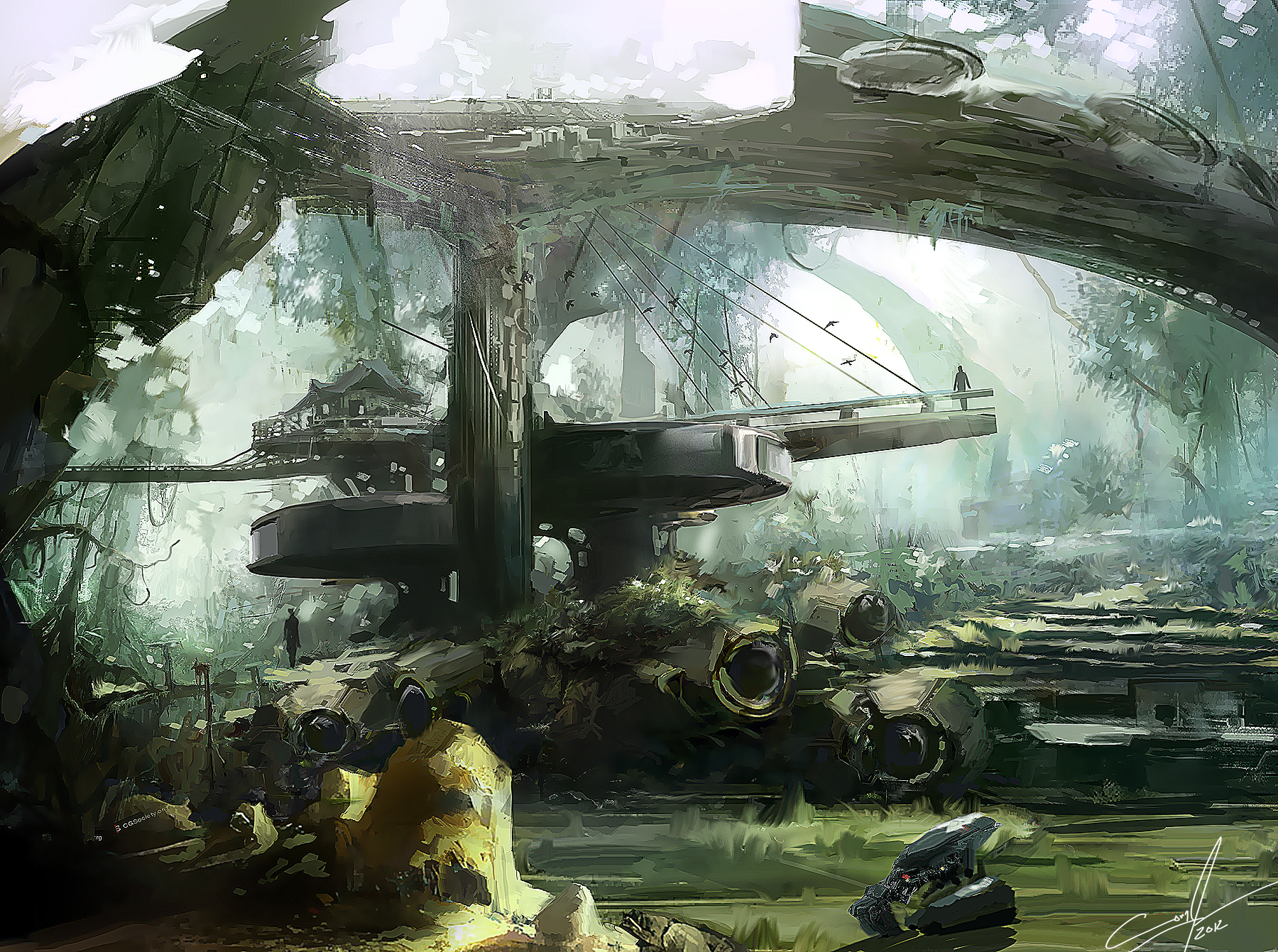
Thinking about the future and about habitations in the future, I always liked the idea of the bio-dome, so I sketched one up. Imagine a dome-shaped Biosphere 2 that you could construct on a polluted earth, or even another planet. My concept here is a closed, domed, hothouse kind of system that could produce its own vegetation, conserve water and atmosphere, and support human life.

Here is my diagrammatic concept:


This concept involves a dense, protective base, coupled with a two-ply sealed dome, supporting vegetation, farming, air, water and all kinds of life. There is a water reservoir at the base and soil in a circular ring, where oxygen-producing plants would grow and humans could live in a jungly paradise. The central column supports the dome and houses all the machinery that would keep the overall life support system working in equilibrium. There is even a suspended farming area.

For further visualization, my friend Cory Jespersen, whose art I featured previously, provided me with an illustrated interpretation, in an advanced state perhaps:

We don’t have any of the necessary engineering down here, but it’s pretty cool stuff, don’t you think?


1 Comment

Random Big Data Idea: “Web Day” Analytics

I’ve been reading Bill Franks’ Taming the Big Data Tidal Wave: Finding Opportunities in Huge Data Streams with Advanced Analytics. It’s a worthwhile read, though it’s written for novices in data science, so if you’re an expert in the space, you might find it dull. Generally, Franks provides a good overview of what the big data buzz is all about and outlines various opportunities to leverage this big data stuff.

Anyway, flying home yesterday from Philadelphia, I was reading the chapter on web log data. There’s just a ton of it, but as Franks notes, a lot of it remains unleveraged. The easier-said-than-done secret in using big data to do interesting things is extracting, structuring, analyzing and then visualizing data in ways that provide meaningful insight. Insight that you can use to take future action. Web analytics, of course, is a fairly advanced discipline, and we can mine clickstream data to extract all kinds of useful information, such as web site performance, user shopping preferences, user segmentation and so on. But there are so many more possibilities, especially as we begin to link data on user behavior across the web (and not just on one web site).

So I had this idea, which I thought was cool. Maybe it’s been done, I don’t know. I’ll throw it out anyway in a numbered list:

1. An interesting unit of web data reporting might be the “Web Day.” If you could connect the data on every user on the web and slice it into unique Web Days, one per user per day, you would be able to capture the details of how people live their digital lives, individually, in segments and in the overall aggregate.

2. The data that you could bring together would be location data, time data, clickstream data and text entry data, among others. It would simply be a matter of stringing together a 24-hour narrative: “user_200431” got on at 6:00 am PST, visited these sites, clicked these links, watched this video, wrote a blog post here, did a specific keyword search on Google, commented on Facebook here, sent emails, logged off at this time, logged back on at this time, clicked here, bought this item from this site, etc.

3. The optics here could potentially be beautiful: imagine an interface where you could click on a single user ID, on a specific day, and see a visual timeline of activity, including site thumbnails, product thumbnails, text snippets, etc. You could drill down into a single activity or time period.

4. The analytics could also potentially correlate and synthesize data. You could query the database and build aggregate models of user segments and multi-day time periods. You could say to the database: give me every user who purchases kids toys online on Black Friday, then give me an aggregate common profile of their daily web activities for the prior week. In such a scenario, you could determine how people prepare to shop, what they are searching for, what influences their purchasing activity on that day, and then do something about it.

5. Privacy issues would have to be adequately handled, so there would have to be a way to mask a user’s personal identity. You could use a non-personally identifiable ID for each user. You’d also have to mask or withhold information that would be personally identifiable such as Facebook IDs and some posted content, etc. I think it could be done in a way that still retains all the really useful information.

6. I imagine such an analytics tool would be huge for brand marketers, sociologists, and people researchers of all kinds. There are many organizations who devote considerable energy to segmentation, trends and consumer insight. You could build this service and offer it to marketers on a software as service model. Sell licenses with monthly or annual fees.

I think you’d want mobile and other non-web data in there too eventually, to make it even richer, and as it gets richer, the privacy issues become more acute. Of course, there are huge technical issues to tackle in terms of tying all the data together in a way that provides valuable output. But there’s a lot of smart people out there, and all problems that are worth solving can be solved.

So that’s Web Day analytics. Cool idea? Creepy? What do you think?


Leave a comment

Voiding the Warranty

Warranties are interesting things. In the most familiar usage, they are commitments a corporation makes to consumers that its products will meet a predetermined performance level. If that performance level is not met, then the corporation will assume responsibility to repair, replace or refund.

These kinds of warranties serve several business functions. They add to the overall value and quality perception of a product offering, and thus help build confidence in consumers at the point of purchase decision. The hope is that any quality doubt in the consumer’s mind can be overcome by the warranty; it may also be that a warranty can sway a consumer to buy one product over a competitive product that may not have a warranty.

On the flip side, companies limit their liability through the warranty, agreeing to pay for this but not that. A warranty can also help a company hedge against poor product quality or limited value in the overall offer.

A symbol of the limitation of liability that warranties imply are those little stickers you see on many products. You know the ones: “Warranty Void if Removed.” And what this always means is that if you open up the sealed system, any problems with the product are your responsibility. There’s also a boundary statement: beyond the seal is a territory reserved exclusively for authorized experts.

Well, if you’re anything like me, you’ve peeled off plenty of those stickers on products, to fix things yourself or to simply learn what’s inside. It’s something I’ve had from childhood: you take things apart to see how they tick. What else are you supposed to do with things? How else can you soup up, hot-rod or customize? Who cares if you’re not an authorized service person? It’s your thing. You own it.

And sometimes, you know, you put things back together the way they were, sometimes in a better configuration, or sometimes not at all.

I think creating the future starts with taking off a hell of a lot of these “Warranty Void if Removed” stickers, in a metaphorical sense. Not just stickers on our laptops, but stickers on our lives, our work, our economy, our cities, our politics, our physical world, everything.

When you open all these things up, of course, you void quite a few warranties. If you reconfigure how you work or live, for instance, you may have to give up whatever security or comfort that the big institutions of work (traditional corporate employment, perhaps) and life (government, “mainstream” society, whatever) guarantee you.

That’s just the way it is.

But it’s your work. It’s your life. You own it.


Leave a comment

Neal Stephenson, Arizona State University and a Tower to Space

I first read about Neal Stephenson’s space tower concept on Google’s Solve for X earlier this year. If you haven’t read about it yet, Stephenson has proposed building a 20-kilometer space tower to facilitate the launch of space vehicles. Because the high-altitude tower avoids a lot of weather and gravity, it should reduce the expense and risk associated with space exploration.

Here’s a recent write up from Kurzweil AI and one from New Scientist.

Also, watch Stephenson’s Solve for X video here:


I’ve been a fan of Stephenson’s work since Snow Crash in the ’90s, so it’s no surprise to me that he has visionary ideas, but what’s great about the space tower concept is that his ideas are connecting with people who can do the nitty-gritty engineering that would make the vision a reality. Specifically, Stephenson is working in collaboration with Keith Hjelmstad of the Fulton School of Engineering at Arizona State University (ASU) to make the tower feasible.

Furthermore, this collaboration is part of ASU’s new Center of Science and the Imagination, an innovative initiative by ASU President Michael Crow to pair the visionary talents of artists and writers with the more practical talents of scientists and engineers in order to make big things happen. Cool, futuristic things.

ASU’s Center of Science and the Imagination launches on September 27, 2012.

As an ASU MBA alum and a veteran of post-MBA tech entrepreneurship studies at the Fulton school, I plan to be there for the launch event and will post how it goes. (Plus, my workplace (eBay’s FetchBack subsidiary) is literally across the street from campus, so it’s convenient!).

Anyway, cheers to Stephenson and ASU: let’s keep putting artists and engineers together and make cool stuff happen.

Design a site like this with WordPress.com
Get started