Kiteba: A Futurist Blog and Resource

Strategic Foresight: Knowledge Ideas Technology Ecology Biology Architecture


Leave a comment

CES 2014: The Thoroughly Connected Human

Guest Post by Tery Spataro

My mad dash through CES 2014 left me feeling exhausted; it was a good thing that I decided not to head for the Oculus Rift, Parrot Mini Drone or Jumping Sumo. I needed to get to 30,000 feet to better understand how all of this stuff comes together to make our lives better. I got excited about the possibilities of being totally connected to my personal data and data from my surroundings.

But, realistically, what does this all mean?

Let’s first take a look at iHealth section of the CES trade show. Health was a highlight and hot topic at CES, with many entrepreneurs and corporations developing products that can either help manage the data retrieved and received from your body and track it back to the healthcare professional, pharmacy and/or insurance company.

spataro_1

There were plenty of health and fitness devices on display at CES, as in the example pictured above. In fact, there were so many waistbands and bracelets to choose from that provide data and behavioral management that my entire arm could be covered by data points. In addition to these types of devices, there were biosensor health patches and pain relief patches “utilizing transcutaneous electrical nerve stimulation” (from Vancive Medical Technologies) and wearable sensor technology monitoring devices. I admit the quantified self in me digs Qardio — these devices make it easy for me to self-monitor my cardiovascular system.  The hardware design is elegant and fits perfectly with human contours. The drawback, however, is that it only works with iOS.

I know, just reading these sentences, you must be overwhelmed too! When thinking about the management of these data, years ago I envisioned that there would be one loyalty card that keeps track of all my loyalty memberships. I hope there is a similar vision regarding the collection of data to and from my body, so that there can be a central synchronization — kind of like a personal human repository of my body’s data. That’s where dashboards can help. There were plenty of dashboards to manage many different diseases, health states and nutrition offering you a choice of iOS or Android. I could #hastag myself to perfect health!

The big take-away from iHealth: WE are going to have to manage our own health, and prevention is becoming more vital. I wonder what this will do for health insurance and healthcare costs. If disease can be prevented by self-monitoring, does the cost of health increase or decrease? BTW, United Healthcare had a very significant presence at CES with an impressive booth.

The only thing missing from our digital health is for Watson [IBM] to assist with patient needs and a biometric toilet to collect samples. Once those items are offered, you will rest soundly knowing your health will be fully taken care of.

I moved from the iHealth section of CES to spend time in Connected Home. If I’m going to fully manage my health, I should be able to combine this with fully managing my home environment.

spataro_2

Since we are living in a data intensive world, connecting the data to you and your home, as promoted in the display pictured above, will take either Zwave or Zigbee, wireless communication protocols designed for home automation. These protocols will need to be considered when you’re buying devices to automate your home. You can be at the center of your hub, making it easy for you to turn your coffee pot on from your mobile device, and regulating the temperature of your home while at the same time being on the road. Even monitoring the activity in your home while you are at work — you will be able to see if the mice are playing while the cats are away. Cisco gave an impressive simulation of what the Internet of Everything may be like in the future. Though, I will challenge the changes in grocery shopping because automation may happen from Amazon. Why waste time grocery shopping when you can kick back in front of your 4K TV, count blades of grass and have a drone drop off your groceries? Please be careful of the eggs!
spataro_3

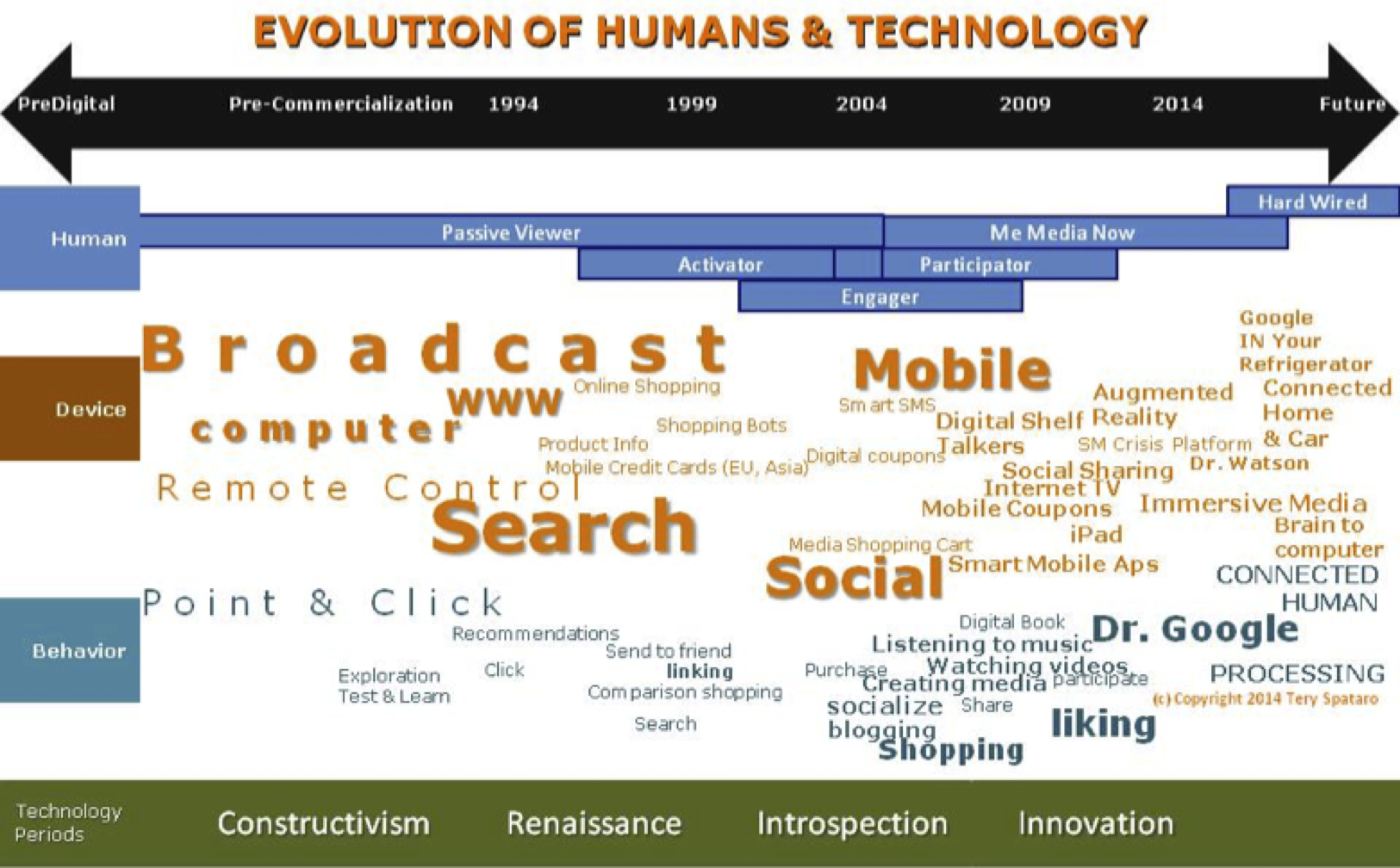
We have come a long way with our technology, as visualized in the timeline above. The term that best describes our future is Connected Human. We will be integrated with our personal and biological data, in our home, life and on the go. Devices will be attached and even inserted into us so that we know what may happen to our bodies before it actually happens.

The automation of my Connected Life will bring me great comfort in knowing my body is being monitored against potential threats — the slightest bit of dehydration, and I will get a prompt to drink more water; if my glucose is too high, my grocery shopping list will change, as will the food that comes to me on a daily basis. My refrigerator will know what to order based on samples my toilet collects, and I will feel secure in knowing everything will be all right. A true introvert’s paradise — I’ll never have to leave home — thus lowering my stress levels as well as human carbon emissions.

But consider this: At what cost will the automation of my connected life interfere with my natural human functions? Will my ability to be intuitive diminish? Will my life be extended beyond what I would like it to be? Will my emotions eventually be regulated by a gadget — making my feeling of love artificial?

These are some things to think about as we become Connected Humans.

LinkedIn- Profile Photo Tery Spataro

Tery Spataro is the founder of the Gilbert Geekery, a firm that focuses on strategy for human solutions, using technology to meet the needs of humans.

Leave a comment

The Seasteading Institute’s Floating City Project

An emerging area of innovative social, technological and architectural development is seasteading, the research and development of cities, businesses, and other settlements at sea. As the burgeoning population of the world quickly fills the available land mass, our oceans represent the best and most accessible open frontier. The blue frontier is one where forward-thinking individuals and organizations will one day live and work on floating cities, free from spatial, legal, social, economic, political and other land-based constraints.

One of the leading proponents of seasteading is The Seasteading Institute, based in San Francisco. According to their website, the Seasteading Institute’s “role is not to build seasteads ourselves, but to set the stage in order to empower others to do so. Our program therefore focuses on business development, engineering and legal research, political and industry diplomacy and building a community of aspiring seasteaders.”

Currently, The Seasteading Institute is running a crowdfunding campaign on indiegogo for their ongoing Floating City Project. Here’s a video for it:

The proceeds of the indiegogo campaign will fund an engineering study from Dutch “water-based urban development” firm, DeltaSync.

Here’s a BBC video in which seasteading and DeltaSync are featured:

The blue frontier is coming, and it may actually be our first step toward space settlement, as many of the challenges and opportunities of space development require similar holistic frameworks of research, development and innovation. Check out The Seasteading Institute’s site for more information.


Leave a comment

Kirobo: A Man-Machine Interface in Space

Japan has just sent a robot to space in order to provide eventual companionship for human astronaut Kochi Wakata, who will be blasting off for the International Space Station in November. The doll-sized robot, named Kirobo, is from Toyota and is part of an experiment, according to the BBC, in how smart android technology could provide companionship to human beings in the lonely watches of space missions.

Kirobo’s creator, Tomotaka Takahashi, is quoted by the BBC as saying he wishes the robot to “function as a mediator between a person and machine, or a person and the Internet, and sometimes even between people.” Kirobo will apparently bond with Wakata, get to know him, and then somehow serve as his interface with the world around him.

Here’s a video from Toyota on the project:

The project is extremely visionary, but in some sense difficult to understand without experiencing it directly. It’s a relationship, after all, and relationships are tough to appreciate from the outside. Here are the simple questions, though: Is Kirobo’s role that of a chaperone? Or that of a good-time wing-man? Or something else entirely?

It’s also so sci-fi, so let’s look at a couple of relevant vintage sci-fi clips, just for fun:

First, the Disturbing Robot Chaperone Scenario Gone Wrong from 2001: A Space Odyssey:

Second, the Equally Disturbing Good-Time Wing-Man Robot Scenario from the old Buck Rogers TV Series:

All kidding aside, we have finally arrived at a time when humans are going into space with semi-sentient android side-kicks, just as sci-fi predicted we would. It will be interesting to see how the experiment turns out, of course, but I can only imagine that it will be a success. Kirobo is likely to be the first of many companion robots in space.


Leave a comment

Tech Nostalgia: My First Computer

My father was an air-traffic controller and spent 40 years in the FAA before retiring. He liked planes, and used to take me to air shows growing up, but he was also an avid electronics hobbyist. He knew the arcane magic of transitors, resistors, capacitors, and he could read the secret code of all the little colored bands printed on them, so he constructed several of the electronic gadgets in our house from parts or kits. He liked to put these gadgets together, but they were also cheaper than buying off the shelf. My dad was frugal too. He still is.

There was a company called Heathkit that sold a wide range of electronics kits via mail order, and Dad was a regular customer back in the 70s and 80s. I remember well helping him with some of his kit projects, which primarily involved me holding soldering wire steady for what seemed hours, while he mounted each little insectoid part to a green circuit board. True lessons in patience.

For many years, my dad also subscribed to magazines like Popular Electronics and Popular Mechanics, which I also read. In 1982, when I was 13 years old, I saw an ad in the back of Popular Electronics for a $100 computer. It was called a Sinclair ZX81, and it came as a kit. I had some exposure to computers and wanted one, but they were expensive in those days. This ZX81 was right in my dad’s zone: a cheap kit. I knew I could persuade him to buy it for me, and he did.

When the little thing came, we soldered it together, connected it to a cassette player and a black-and-white TV I had, and I entered the computing age.

I still have this ZX81, its accessories, literature, software and ephemera. My dad saved it all for me in the same box the computer originally shipped in. He had squirreled it away when I went off to college, marriage, fatherhood, etc. He sent it back to me recently, and it’s like a little time capsule.

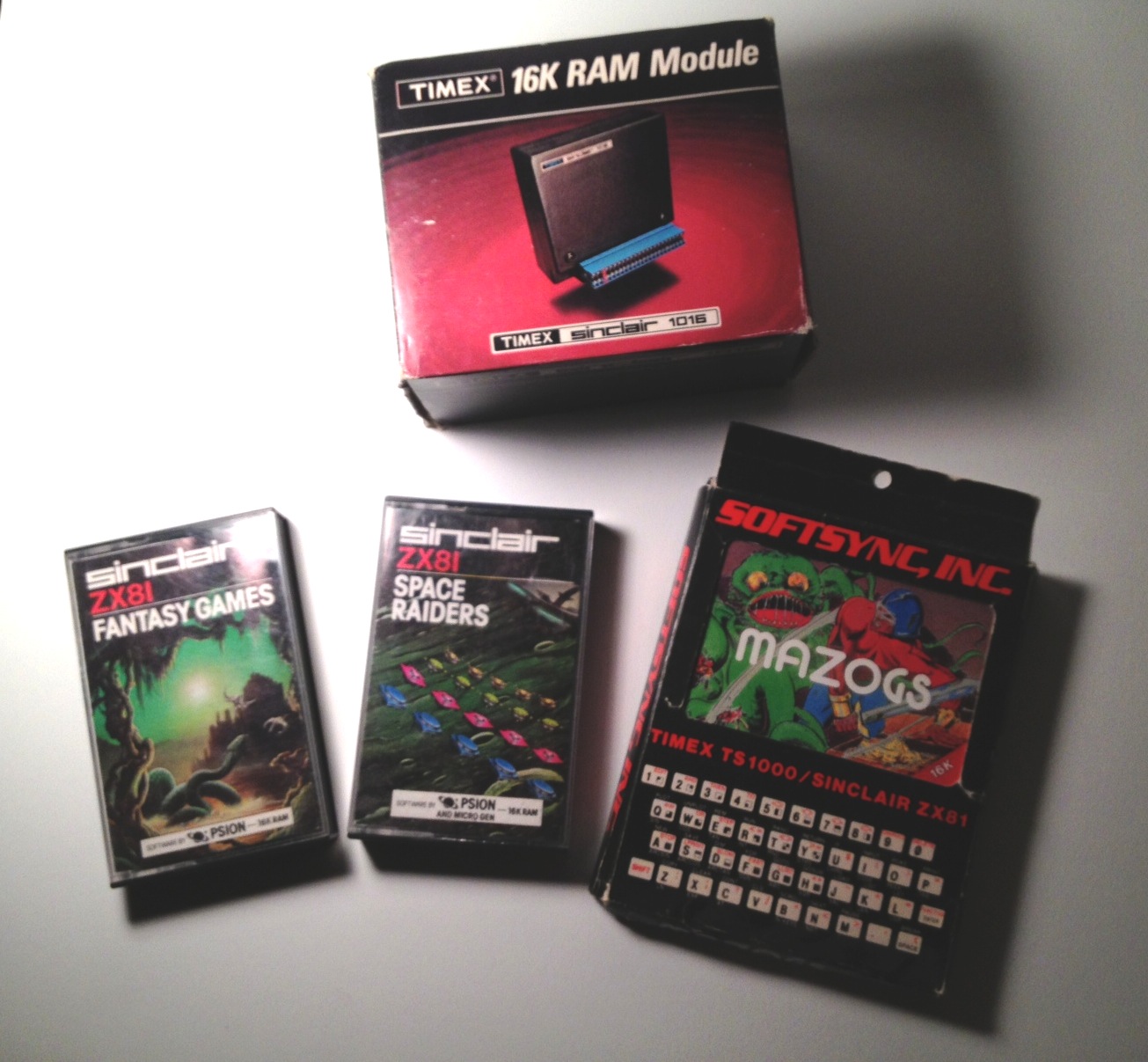
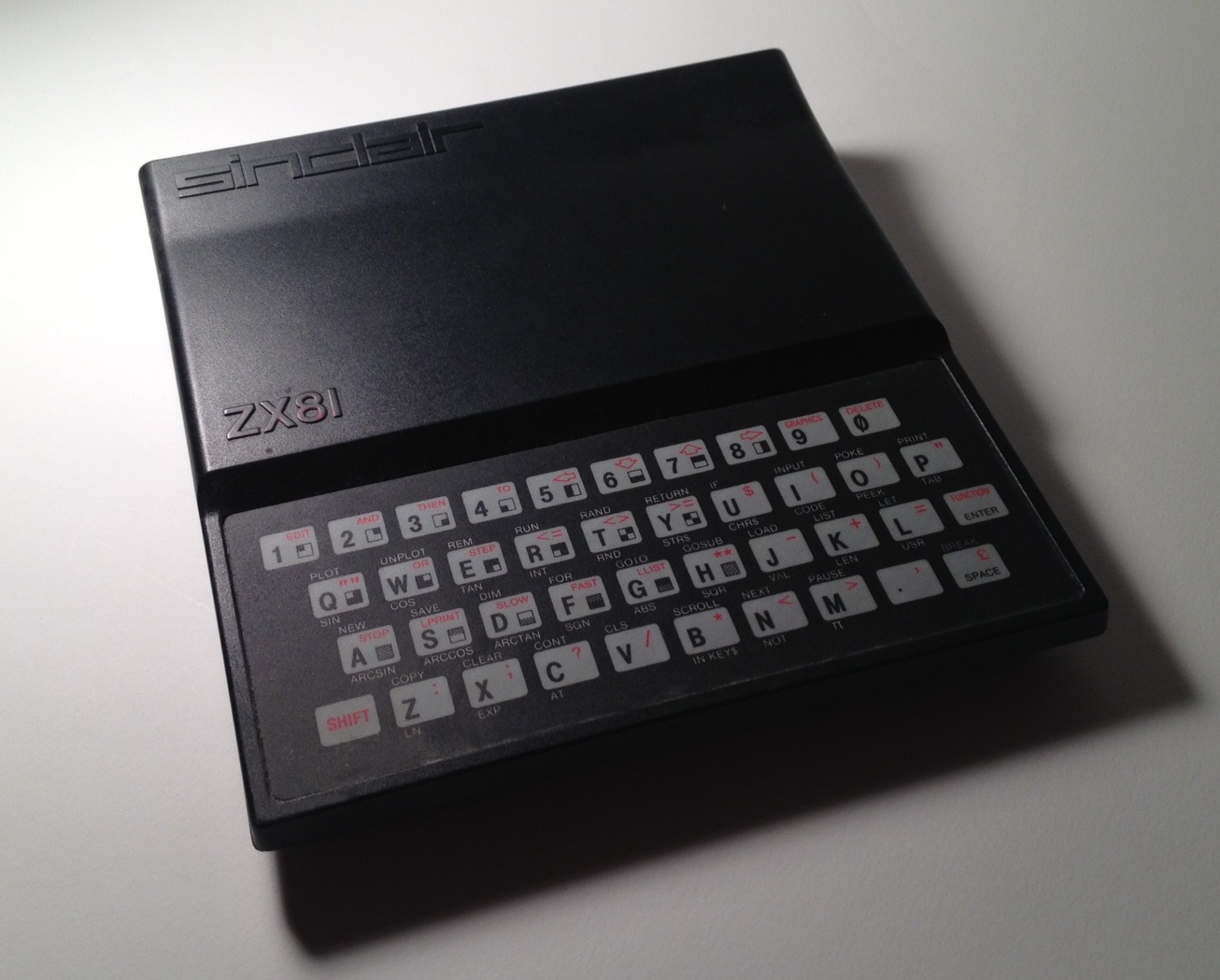
Here are a few photos of my ZX81 and accessories (taken just now with my iPhone, so they’re a little dodgy):

photo1

I still have Dad’s receipt, pictured below. I’ve blotted out address and credit card number, though I assume Dad doesn’t still have the same credit card number as he did then (expiration 07/82). The computer kit was shipped from Sinclair Research in Nashua, NH, although the back of the case assures me it was made in England, the home of Sinclair.

photo (4)

Total cost = $104.90 and an afternoon of assembly. Sweet deal.

Then, as now, you had to buy stuff for your computer. The ZX81 came with 1k in RAM, so to do anything useful you had to buy a 16k RAM expander, which I bought later (note the Timex brand; Timex sold Sinclair products later in the US). The games pictured below, by the way, were awesome.

photo (2)

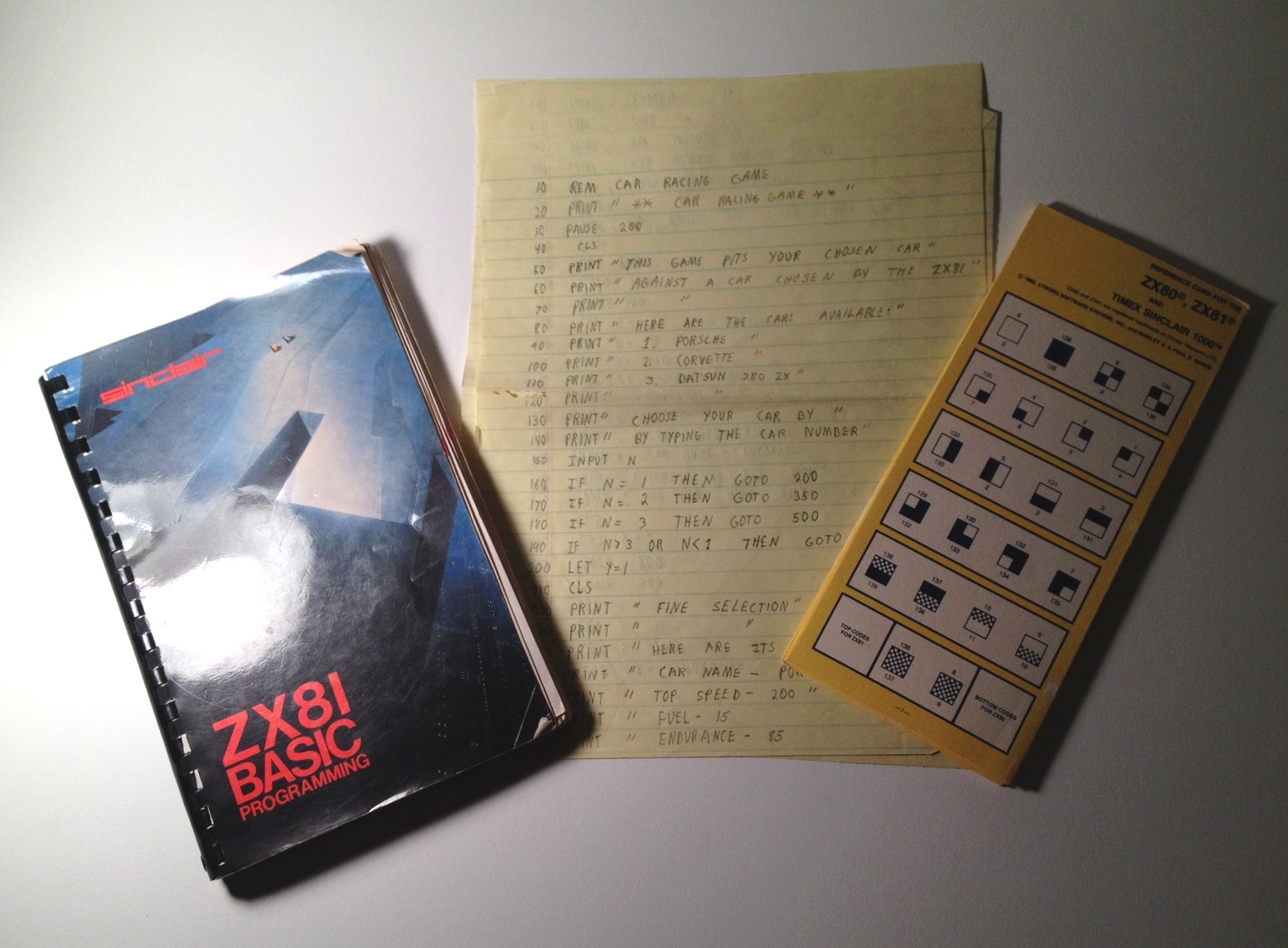
But the real fun of the ZX81 was learning to make your own stuff, learning to code. It came with a manual for its version of Basic, along with a shorter quicker guide. In the time capsule, my dad saved the code for a bunch of little games and programs I had written out on legal pads. The picture below shows the Basic for “Car Racing Game.” Not a very catchy title, but hey, I was 13.

photo (3)

So we’ve come a long way technologically in 30 years. It’s a trivial point, yes, but I think looking at artifacts like the ZX81 really brings it home. The MacBook Pro I’m writing this blog on is probably further away from the ZX81 than the ZX81 was from ENIAC. Right now, by the way, my 10-year-old son is on his own MacBook Pro (his first computer), wreaking virtual havoc on some multiplayer Minecraft server. Thirty years hence, who knows what he’ll be “computing” with?


Leave a comment

Private Space Spotlight: Space Adventures

Virginia-based Space Adventures has been around since 1998 and has already posted some meaningful accomplishments along the evolutionary path to a future of private space travel. The company promotes and works actively on early-stage space tourism, and according to their site, they “are the first and only company to have sent self-funded individuals to space. [Their] clients have cumulatively spent close to three months in space and traveled over 36 million miles.”

Some of Space Adventures’ recent projects include partnering with Boeing on the new CST-100 space capsule (pictured below), which is being designed to ferry astronauts (and tourists) to the International Space Station.

Here’s the interior:

Here’s the exterior:

Cool stuff.

As we move rapidly toward private space travel, it’s not difficult to imagine the possibilities for private individuals. As with any early-stage techno-economic ecosystem, the costs and prices are high now, open only to early adopters, and the industry players are few and small, but there is so much momentum that private space travel is not a matter of “if” but rather of “when.”

If you’re into space, it’s worth checking out Space Adventures. I’ll leave you with a video in which the company’s Chairman and CEO, Eric Anderson, talks about going to the moon.


Leave a comment

Google Appears to Move Toward an Internet of Things Strategy

A recent piece on Quartz quotes Google exec Sundar Pichai saying the company’s goal is to “put computing everywhere,” suggesting that the company is moving from its legacy position as the organizer of “the world’s information” to a new ubiquitous-computing position in which it provides the operating system for the coming Internet of Things. Having been on something of an OS and hardware journey since developing the Android phone OS and now the Google Glass, it seems a logical and prescient extension for a company with such a global vision and the proven ability to conceptually grasp and then shape massive connected territory (e.g., the internet itself).

I wrote some time back about the relationship between Google’s model and the psychogeography of data, my thesis being that the company itself has both the vision and power to shape the world, and the power that it wields is directly connected to psychogeography, or rather “psychogeoengineering.” Here were my key points:

1) The web is nothing more than the first iteration of a future world that is pure datasphere. We will all live in that world. It will shape us. It will teach us. It will define what is possible and what is not. It’s already happening, but it’s just begun.

2) Page Rank and algorithms like it will be primary forces of nature that will do nothing less than shape and define the world we live in. And who we are, what we can be. It’s already happening, but it’s just begun.

3) Specifically, the search engine scuplts the psychogeography of the datasphere in which we all live. By favoring some data, and starving off others, Google and things like Google passively and actively delimit what data exists in the world, according to their own logic and judgment, and thereby (I repeat) define the world we live in, shape what we can think and who we can be.

4) And thus, Google is nothing less than a kind of demiurge cartographer of a living world of data: they are mapping (and through mapping, creating) our digital world for us. They are creating/mapping our intellectual, social and cultural possibilities, no less, and it’s no surprise that they long ago set about to map (or re-map) the physical world too. It’s all the same project of psychogeographic engineering.

So, now I add this, and I don’t know why I didn’t draw it out then:

5) The convergence of data and smart technology with ubiquitous computing, and thus the Internet of Things, will not only give Google the ability to remap the world virtually, but also in a very real, physical, experiential way. By putting computing into everything, and linking everything, plugging it all into the datasphere, Google will potentially be able to monitor and influence every built environment in the world, as well as your individual possibilities within it.

Such potential power, if realized, is unprecedented. It’s the physical world become datasphere, and the datasphere made physical, powered, monitored and defined by Google and things like Google.

I may be overstating things, so please comment if you think I am, but Google thinks big, their actions follow their vision, and we should all do what we can to understand the world they wish to create, because we may soon find ourselves living in it.


Leave a comment

Tery Spataro’s Confluence of Man with Machine

The convergence of man and machine represents one of the most significant and (historically) enduring futurist themes. It should be obvious by now, with technologies ranging from Google’s Glass to mind-controlled prosthetics, it’s gone beyond sci-fi visionary terrain and into our shared contemporary lives. The man-machine convergence is impacting the individual, organizations, society, and culture, albeit perhaps in peripheral and subtle ways. And it’s really just beginning

Here’s a great slideshow meditation on the man-machine confluence from my friend, the futurist Tery Spataro, which was just published on the IEET site:


Tery considers many sides of the big issue here and justly recommends we think deeply about where we’re going with all the various trajectories related to man-machine integration. Tery was kind enough to quote my concern for the ontological dimensions at work: for me, there’s a deep connection between man-machine confluence, the internet of things, and recent philosophical work on object-oriented ontology. In particular, I refer to the work of people like Graham Harman and Levi Bryant that reduces/re-situates humanity into dynamic systems of objects, each with their own form of potential agency; it’s easily extended into an ontology of man in the network of machines, a place where robots and the singularity make metaphysical sense, but also a very different place from our humanistic/anthropocentric heritage.

Great stuff, Tery.


Leave a comment

White Spaces Worth Exploring

I just finished Seizing the White Space: Business Model Innovation for Growth and Renewal by Mark W. Johnson. It’s a strategy book about business model innovation. Business models are the core ways businesses create, deliver and realize value, and the idea is that in order to move into the future, and avoid obsolescence, many businesses may need to reinvent or change business models. A retailer might shift focus from moving goods to providing services, for example, or a software company might move to cloud applications. You provide new value, make money in new ways, and stay relevant in times of technological, consumer and social change.

Johnson’s “white space” is simply “uncharted territory beyond a company’s core business.” It’s that scary, untried, new stuff full of risks and potential rewards.

It goes without saying, of course, that the ideas of white space and innovation in general apply to more than just business. They apply to the public sphere, the non-profit sphere, society, culture and, well, life in general. It’s all interconnected. To chop it up is to miss both understanding and opportunity.

So, thinking very broadly of white space, the future, and opportunity, here are three “white spaces” I believe to be worth exploring (“seizing” seems a little too aggressive for these broad areas). These white spaces will provide opportunities for new models of all kinds, new products, businesses, and socio-cultural practices, and they may pay out for a long time. I realize I’m using the “white space” term loosely here, but if you’re looking ahead to find places to begin to solve problems, provide solutions, and build businesses, consider the following:

1. Empowering Individuals — Human beings live in a network of constraints on one hand, and increasing limitations, but we’ve never been more demanding. We want to control our lives and our destinies, from the very mundane aspects to the big picture. It’s just hard to do. New models, products, technologies or techniques that give individuals more power over our lives will never be more welcome than in the next 10 to 20 years. Education is a big deal here, but there’s so much more opportunity.

2. Connecting Organizations with Individuals — I don’t just mean advertising or one-to-one marketing here, but authentic, deep connections. As individuals become more empowered, and thus more individualized and fragmented, organizations such as governments and businesses risk losing meaningful connections (and thus relevance). Any model, technology, or product that can really bridge the widening gaps between individuals (as consumers, students, citizens, employees) and organizations (as industries, schools, governments, employers) will pay out in all kinds of dividends. There is risk here too: if we can’t make this work, we’ll see a lot of failed companies, governments, etc. It could get ugly, but it doesn’t have to.

3. Re-Engineering the Economy around Self-Actualizing Livelihoods — Forget about the old concepts of buyers and sellers, corporations and consumers, jobs and workforces. The two trends above, along with the alt economies that new technologies have spawned, will change the economic focus from jobs to livelihoods, and the individual’s focus from a wage to self-actualization. If you can develop models, platforms, technologies to re-engineer the economy, or parts of the economy, to facilitate the need for self-actualization, you’ve got something that will resonate.

So those are three big, broad white space areas. If you have an idea for a new business or organization, ask yourself if it can play into one or more of these spaces. Chances are, if it does, it’s worth working on.


Leave a comment

Business Concept: Device Subscription Service

laptop

Here’s a “why isn’t somebody doing this” business concept: a device subscription service wherein you no longer need to buy a PC and/or tablet but can pay a monthly subscription fee to have full use and possession of a computing device of your choice and configuration.

Think Netflix meets Dell: for fifty dollars a month or so, you get a membership that allows you to log on, choose a PC or Mac laptop and/or tablet, in one of several pre-loaded software or feature configurations, and it’s shipped to you for your use, as long as you want to use it. Plus, you get a cloud storage solution that allows you to back up your personal files. When you’re done with the machine, or want something new, just send it back (prepaid) and you’ll get another one. All you have to do is keep making payments and you’re always in the latest gear.

Of course, if you wanted to build a business like this, you’d have to work out the various terms and conditions. For instance, you’d want to hold customers liable for failing to return a device or failing to pay their subscription fee (at which point, you charge them for the device and freeze their storage account). You’d also need to validate the business model to make sure you can do it all profitably and effectively deliver on the value proposition of providing customers with the latest gear without them having to pony up the full purchase price in one lump sum to own it.

It would be great for students. Heck, for everyone. The company owns servicing the machine too, so if something fails naturally on it or it gets overrun with malware, the consumer just sends it back, gets a new one, and the company fixes and cleans up the old to put it back in circulation.

A successful business like this would disrupt the ugly low-margin PC sales industry that most consumers don’t care much for anyway. Plus, it would totally remove the maintenance problem that most consumers have never really enjoyed dealing with ever. As a service to humanity, it would be great to get a better solution going here.

If this service already exists, I’d love to hear about it. I couldn’t find it, so it must not be to national scale yet, or else I’m bad at finding things. Which is entirely possible. Either way, this one seems so obvious; I’m sure it’s occurred to others before.

Honestly, this is what Dell should try next, but they probably won’t, so if you got a big chunk of investment money burning a hole in your pocket …


Leave a comment

Currency Space Race: PayPal Fires the First Shot

Today, PayPal announced its PayPal Galactic initiative, an effort to open up awareness and discussion of issues related to finance, commerce and currency in an interplanetary economy. The initiative is a partnership with the SETI Institute and “others in the scientific community.”

According to the press release, PayPal Galactic “aims to bring together leaders in the space industry to work on the big questions around the commercialization of space. These include:

• What will our standard currency look like in a truly cash-free interplanetary society?
• How will the banking systems have to adapt?
• How will risk and fraud management systems need to evolve?
• What regulations will we have to conform with?
• How will our customer support need to develop?”

Here’s the video of the launch event.

http://youtu.be/UkS-ocBzdOo

A future of space travel, tourism, commerce and colonization needs a currency, sure. PayPal’s assumption is that this interplanetary future will likely be cash-free and unified into one society. While everything is forecastable, nothing is foregone. All kinds of futures are possible, however, right?

At present, on Earth, our monetary systems are tied to the global network of sovereign states and financial institutions, and space finance may be extended from this framework, but it may not necessarily be so. Like the seasteading movement, where parties seek out international waters in order to liberate themselves from the laws and regulations of sovereign states, humans in space may have their own ideas.

Personally, I have always imagined that we might see something like corporate scrip in space. Space ventures, especially private ones, are likely to be focused entities unto themselves, and historically on Earth, many self-contained corporate entities such as mining camps or factory complexes (even in such places as the Soviet Union) have issued their own currency/scrip for purchases in a self-contained company economy.

Maybe it won’t happen that way. Or maybe it will in some instances, but not for long. You could argue that eventually the need to exchange will standardize a fragmented currency situation, yet Earth itself does not have one currency. Perhaps space will offer currency exchange opportunities that we cannot at present predict.

But other configurations are possible. Look at recent alternative money movements (such as Bitcoin). Could there be space currency or currencies that are stateless, unpegged, freed from any corresponding collateral or institution? Could it be wild and fragmented and disconnected from nation states and other terrestrial economic constructs? If so, what would be the basis of value? I think there’s innovation space here, worth billions of dollars.

Anyway, space finance is wide open at this point (which makes it fun to speculate, pun intended).

It’s great that PayPal would like to get in front of the situation, and I salute PayPal Galactic for their effort.

[Full disclosure: I am an eBay employee. eBay owns PayPal. But I have no involvement whatsoever in PayPal Galactic. Unfortunately.]

Design a site like this with WordPress.com
Get started