Kiteba: A Futurist Blog and Resource

Strategic Foresight: Knowledge Ideas Technology Ecology Biology Architecture


Leave a comment

McKinsey Piece on The Internet of Things

Interesting McKinsey & Company piece on The Internet of Things:

The Internet of Things and the Future of Manufacturing

“Executives at Robert Bosch and McKinsey experts discuss the technology-driven changes that promise to trigger a new industrial revolution.”

The view here may be through a traditional manufacturing and logistic lens, but that’s where the first order impact is likely to be.


Leave a comment

3D Printing Goes Ballistic

If you’ve read some of my previous posts on 3D printing, you know I’m a big fan of what the maker movement means, creatively, economically, and ontologically.

If you’re not up to speed on 3D printing and the ecosystem that’s rapidly cropping up around it, check out Make Magazine or MakerBot. It’s a huge movement that is rapidly integrating with other online creative communities. You can even design something in the popular online game Minecraft, for example, and print it in 3D with an application called Printcraft.

At a very high level, the maker ecosystem reminds me of the old Platonic concept of ideal forms, downloaded from an incorporeal space of perfect, unitary objects and made immanent in multiple iterations of imperfection in our world. All things imaginable are possible, or will be soon.

One anticipated and/or feared sci-fi outcome of the 3D printing revolution was that we would be able to one day download and print out weapons (I even alluded to it in a sci-fi short story I posted here some time back), and lo and behold, the future is here.

According to this article on WebUrbanist, the first 3D printed gun has been fired. Here are images of the parts and of the gun in action:

The plans for the gun were made available by a site called DEFCAD, an offshoot of an organization called Defense Distributed, which is apparently devoted to providing 3D plans for objects prohibited from sites like MakerBot.

The Feds are up in arms a bit about the gun, as one would expect. Any DIY movement that skirts the mechanisms of social control (i.e., laws) is likely to be curtailed, but the gun to me is a watershed for the movement: 3D printing gets a little more real, it gets some teeth, it gets dangerous.

Whether that’s good or bad depends upon your perspective. Either way, it was inevitable, and it points to the growing sophistication of the technology and the movement.


Leave a comment

A Quick Observation

When encountering any new situation, person, or idea, it is better to assume an attitude of learning than an attitude of knowing.

By which I mean, of course, that our past experiences, frames of reference, and classification schema are likely to inhibit our ability to comprehend.


Leave a comment

Mars One: A Private Mars Colony Project

As governments withdraw funding from space exploration, private enterprises have been popping up around the world to fill the gap. From the X Prize to Virgin Galactic, significant strides have been made in private sector aerospace, and for better or worse, it seems our interplanetary future belongs not to governments but to corporations and plucky space startups. 

After all, the future always already belongs to the visionaries, and the vision is coming from private enterprise.

Consider this Dutch Mars-colonization project from Mars One:

What a great video, and what a great concept. Whatever the project’s feasibility, which this BBC story questions, Mars One is talking about a permanent settlement, funded through the spectacle of media, with settlers for life, who never return to earth.

That’s visionary, that’s going all-in. That’s what the future needs.


Leave a comment

You Don’t Know Me (Yet)

Our expectations evolve all the time. As consumers and human beings, we have infinite needs and wants. Give us a resource, and we want more of it. Technology and product development plug themselves into this cycle of infinite need. Give us a tool, we want a better one, and there’s a commercial opportunity in providing it. It’s the continuum of advancing expectations, and the fulfillment thereof, that fuels our development as human beings, societies, economies and cultures.

Currently, the internet and digital technology are the big catalysts of the expectation-fulfillment continuum. One aspect of digital technology that is advancing rapidly is personalization. Data and messaging technology are being synched across devices and geographies to provide organizations the ability to target advertising, content, and offers to individuals based on their known preferences and/or expectations.

You see it online, in targeted ads and dynamic native advertising, and increasingly, you will see it in the real world, offline. Targeting and personalization have stirred some concern among consumers for privacy, and some concern on the part of techies, such as Eli Pariser, whose book The Filter Bubble raises the concern that as content becomes more personalized, we may become more narrow and self-absorbed in our own biased comfort zones.

But the funny thing is that it’s almost impossible to stop the expectation-fulfillment continuum once it gets rolling. Personally, I find myself beginning to perceive content that is not targeted to my preferences as more irrelevant than ever and the providers of non-personalized content as hopelessly behind the times. I perceive them as almost unworthy of my attention and business, because they don’t know me.

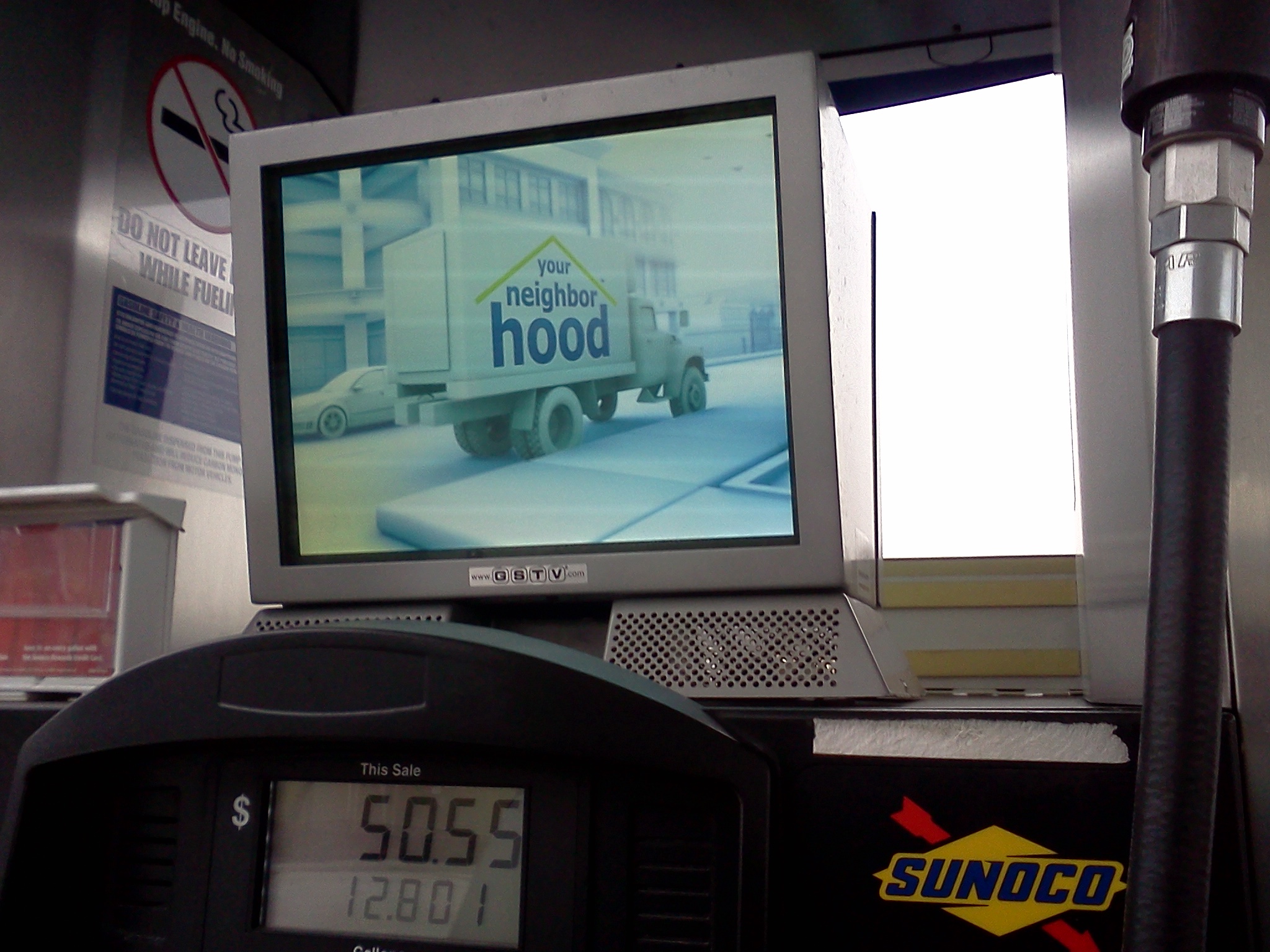
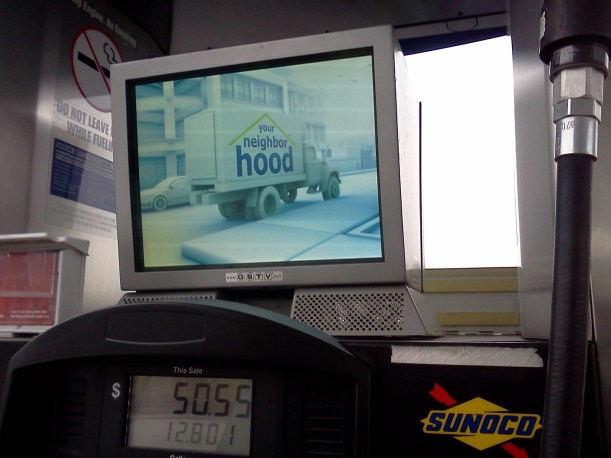
A case in point, I stopped at a Sunoco service station outside Philadelphia recently, where each pump was mounted with a video display, complete with sound. The content was all about Nascar, moving services and Sunoco itself, not well aligned with my interests, and thus it was a mildly irritating experience.

As the photo below demonstrates, I stood pumping for quite a while, forced to view (how could I look away?) and listen to content with no relevance to me.
IMG_20130205_123029

Similarly, in a cab in midtown Manhattan last week, there was a video display mounted in the back seat, but the content there did not reflect my interests either — family sitcom snippets from shows I don’t watch.

I know there are technical challenges to personalizing offline content, all the messages in the “internet of things,” but if I’m any indication, the consumer expectations have shifted. My phone, my credit cards, and any number of identifiers will make offline personalization possible very soon.

Despite concerns for privacy and insularity, a world in which content “doesn’t know me” may soon be a thing of the past.


Leave a comment

Sensing the Future: IBM’s 5 in 5

January is a great a month for thinking about the future. The old year is over and a new one is about to unfold. We naturally start to look out at new horizons from the perspective of a new year. January’s also a great time to publish new predictions, new thoughts, new visions.

Here’s an interesting new vision of part of the future from IBM Research. It’s part of their “5 in 5” series: a prediction of five innovations that will change our lives in five years. This year, it’s the five senses in focus. Specifically, IBM researchers see computers/technology being able to see, touch, hear, taste and smell, as well as enhance the way we sense, in about five years.

Here’s the 5 in 5 overview video:


From the overview video, you can navigate to the other videos in the series.

If you have ever read about the complexities the human brain manages in receiving and processing sensory stimuli, or have ever worked on or read about efforts to develop artificial analogs, you know that the processing power required in handling sensory data is huge. Yet we are beginning to develop the computing speed and depth to manage large data sets and perhaps also to fully contextualize such complex data.

Of course, some of what the IBM folks predict includes not just sensory processing for machines, but also sensory enhancements for human beings. Inevitably, we are on a trajectory to converge with our technology.

The technology is exciting, and the applications many, and interesting old questions are raised: if perception is reality, what reality will computers assemble from their sensory data, once they are sophisticated enough to put it together? We go back then to some of the most fundamental issues of western philosophy when we pursue such questions. What is the distinction between perception and reality? What is the difference between consciousness and the aggregate gestalt of our senses? Similarly, what might we begin to see and be when we can see and be more, when we transcend our biological limitations?

It appears, according to IBM, we won’t have long to wait for answers.


Leave a comment

What Chaos Really Is

The pace of change in our hyper-connected, tech-driven world is unprecedented, and it’s only natural that from time to time we might feel a little disoriented. This disorientation is a prelude to fear, of course, so it’s not uncommon to hear in the press, or from our colleagues and friends, the suggestion that our world/society/industry/profession is descending into some degree of chaos.

I suspect that the chaos-mongers fall into one of at least two camps. There are the (usually older) folks genuinely alarmed by change, who usually have some stake in the status quo and who are afraid of and confused by new forces that threaten that status quo. Then there are the (usually younger) folks who would like to posit this sense of chaos as either a failure of the status quo or an entirely new paradigm which only they can reform/process/navigate.

As a futurist, and a student of sciences, statistics, and complex systems, I would argue that there is simply no such thing as chaos. Chaos, by definition, is a lack of order. The sense of unpredictability and randomness we perceive in our environment is not a lack of order. It is rather one of two things (or both): new patterns and structures or new levels of complexity in existing patterns and structures.

The fact that everything is bigger, deeper, faster and more interconnected certainly means that it’s more difficult to perceive the structure in the complexity, but that does not mean there is no structure.

Therefore, we would do best to think of our own individualized perception of chaos not as a reality of chaos in the world, but rather as our own (hopefully temporary) inability to perceive the underlying patterns and structures of what’s going on around us.

In other words, frankly, the perception of chaos is a confusion that comes from our own (again, temporary) ignorance, so the best approach any of us can take is a skeptical, learning approach: get the facts, study patterns, and don’t panic or fall for anyone else’s hysteria.

Our world is changing on an unprecedented pace and scale. It’s becoming more complex.

But it’s not chaos.


Leave a comment

Roboxotica 2012: A Cocktail Robotics Festival, December 6-9

My last post on human-machine symbiosis made the point that maybe we, as human beings, are starting to get more and more accustomed to having machines in our lives. That post also touched upon the more sophisticated and natural roles human-like (and increasingly smart) machines are beginning to play in servicing human needs, particularly around things like food and drink.

It turns out, believe it or not, that there’s a festival for human-machine symbiosis, food, and drink. Roboxotica 2012, which takes place in Vienna, Austria, this weekend (December 6-9, 2012) seems to be just that — an awesome social event dedicated to what the organizers call “cocktail robotics.”

Click on the image below for more information:

According to the official festival website, this event celebrates our silicon servants and computer-controlled companions:

“As robots have a growing number of different applications, the cases that involve interaction with an end-user are also growing. Progresses in the development of service-robots in the service of households and the elderly and also culinary proofs of concept, during the first decade of a new millenium, have been very promising.”

So it’s a celebration of service robots, and I’m delighted such an event exists, but I’m bummed I can’t be there. If you can’t be in Vienna this weekend either, please join me in a virtual toast to the service machines.

Cheers!


1 Comment

Human-Machine Symbiosis: Let’s Start With the Soup Again

A brief reflection on the evolution of machines and on the evolution of our attitudes toward human-machine symbiosis.

The archetypal dumb machine, with its mechanistic instruction set and poor human factors, used to be humorous, as in this old Charlie Chaplin clip from “Modern Times:”

There was something absurd, and thus funny, about the juxtaposition of the organic process of food or eating with the technological processes of machinery. We could laugh at the logical, assembly-line programming and the cold insensitivity of both function and malfunction. Such depictions as this clip were consistent with an early twentieth-century theme of critiquing technology and industrialism as inadequate, even antithetical, to human interests. The symbiosis of humans and machines was depicted as a forced and tense one at best, ineffective or offensive at worst.

Fast forward 80 years, and we see the emerging reality of smart machines, such as this robot butler from Japan:

Not the same kind of clip, I realize, but a common feature: the juxtaposition of food and technology. But it’s not absurd like the Chaplin bit, or at least not absurd in the same way.

My reaction is that, in the case of the robot butler, if taken as representative of machine evolution, the synthetic interfaces with the organic in a much more human-like way. The humor here, if you find any, may be in the painfully slow, clumsy mimesis of human motion. I smile, yet I can’t help but accept the robotic butler. The machine is okay there, in the kitchen handling food; there’s nothing dehumanizing about it. Its machine-ness doesn’t threaten me in the same way the mechanization of life may have threatened Chaplin’s original audience. There’s simply more comfort and naturalness in the symbiosis of humans and machines here.

Finally, it’s worthwhile to reflect on where we might be now on a continuum of specifically “android” evolution. The technology is getting better, though it’s not quite there. Symbiotically, our openness to human-like machines is likely evolving as well, and this is critical in order for the technology to continue to improve. Put another way, our collective human willingness to be symbiotes with androids will define the degree and pace at which the machines evolve.

When we’re ready, I suspect, they’ll be ready too.

Design a site like this with WordPress.com
Get started